Quantum-internet stacks
A quantum-internet protocol stack faces design constraints absent from TCP/IP: no-cloning forbids store-and-forward retransmission, the link-layer service delivers an entangled resource rather than a bit stream, and the network coordinates two-way classical communication alongside the quantum channel RFC 9340 .
Seven proposals have shaped the field. The first wave (2014–2019) mapped classical-style layering onto quantum networks: Van Meter, Wehner, Dahlberg, and Pirker. RFC 9340 (2023) consolidated their shared architectural principles and remains the only document with IRTF consensus. Two new directions emerged in 2026 — the Lopez operator-facing multiplane draft inside the IRTF, and the Cacciapuoti academic quantum-native architecture — and a third proposal (Caleffi 2026) argues that layering itself should be abandoned. The field has an anchor; it does not yet have an agreed successor.
Side-by-side comparison
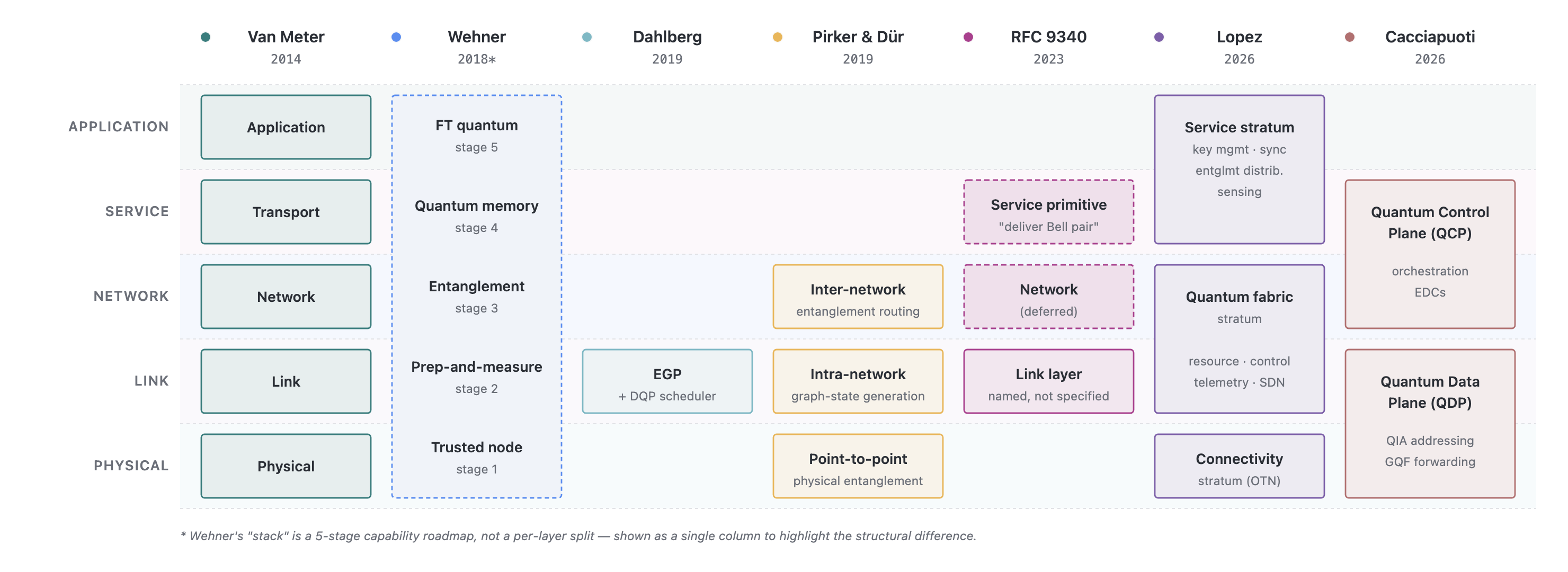
The seven proposals share five functional bands — physical, link, network, service, application — but disagree on how many layers to split them into, whether to use planes instead, and which concerns belong inside the stack versus outside. The figure aligns each proposal's layers to the bands; missing bands indicate either out-of-scope or deferred.

The first wave (2014–2019)
Four proposals defined the early literature. Each took a different cut at the same problem.
- Van Meter 2014 — the earliest comprehensive stack. Five layers mapped onto TCP/IP structure: physical, link, network, transport, application. Entanglement generation sits at the link layer, purification and routing at the network layer Meter 2014 .
- Wehner 2018 — a five-stage capability roadmap rather than a layered split. Stage 1 (trusted-node QKD) through stage 5 (fault-tolerant quantum computing across the network) each unlock a class of applications. Influential as a strategic framing; less useful as a wire-level architecture Wehner et al. 2018 .
- Dahlberg 2019 — the first concrete protocol design for the link layer specifically. The Entanglement Generation Protocol (EGP) requests on-demand Bell pairs with a target fidelity; the Distributed Queue Protocol (DQP) schedules competing requests across two nodes. Implemented on the NV-centre stack at Delft Dahlberg et al. 2019 .
- Pirker & Dür 2019 — a three-tier recursive-modular stack. Tier 1: point-to-point physical entanglement. Tier 2: intra-network graph-state generation. Tier 3: inter-network entanglement routing. The recursion lets a failure of a whole sub-network be compensated by re-routing at the next tier up — a property absent from the Van Meter and Wehner framings Pirker et al. 2019 .
RFC 9340 — the current anchor
RFC 9340 (IRTF, 2023) is the only quantum-internet architecture document with standards-body consensus. It is informational, not a wire-protocol standard — it names requirements, layer boundaries, and a shared vocabulary, but does not specify on-wire formats RFC 9340 .
Three principles carry the document:
- Bell pair as the network resource. The network's product is entanglement, not bits. Applications consume Bell pairs; the success metric is entanglement-delivery rate × fidelity, not bandwidth.
- Classical co-routing. Every quantum protocol needs a classical side-channel for measurement results, corrections, and heralding signals. The classical channel is in-band with the quantum service; the stack schedules both.
- Deferred concerns. Naming, addressing, routing, and the control plane are acknowledged as open. The document calls these out so implementations don't accidentally invent incompatible solutions.
The 2026 proposals below are explicit attempts to fill in what RFC 9340 deferred.
Post-RFC-9340 directions
Two architectures from 2026 represent the current frontier — and they pull in different directions.
Lopez multiplane (IRTF draft, Feb 2026)
The most operationally concrete post-RFC-9340 document. Three strata, each with four internal planes (resource, control, telemetry, SDN intelligence): a Service Stratum exposing key management, entanglement distribution, synchronisation, and sensing; a Quantum Fabric Stratum executing the quantum protocols among link endpoints; and a Connectivity Stratum for the optical transport paths (OTN-based) that carry both quantum and classical signals draft-irtf-qirg-qi-multiplane-arch-01 (Feb 2026) .
Drafted by Telefónica, UPM, and IMDEA Networks — a telecom-operator perspective. The SDN plane decomposition per stratum is novel against RFC 9340's principles-only approach. Adopted by the IRTF QIRG as a working draft in February 2026; the most likely near-term IRTF successor to RFC 9340.
Cacciapuoti quantum-native (IRTF individual + IEEE T-Comm, 2026)
Two planes — the Quantum Data Plane (QDP) for forwarding entangled qubits (ebits), and the Quantum Control Plane (QCP) for lifecycle orchestration. Three mechanisms span both planes: Quantum Internet Addressing (QIA — node identifiers encode quantum state via a Schrödinger-oracle splitting), Generalised Quantum Forwarding (GQF), and Entanglement-Defined Controllers (EDCs) Cacciapuoti et al. 2026 .
The argument: a control plane that routes entangled packets cannot be classical-bit-based — the addressing scheme itself must be quantum-native. The companion IEEE T-Comm paper specifies the routing mechanism; together they constitute the first complete architecture post-RFC 9340 with both addressing and forwarding fully specified. Academic / ERC-funded provenance, still an individual IRTF submission rather than an adopted draft.
Beyond layering — the post-layering challenge
A third 2026 proposal rejects the layered model itself. Caleffi & Cacciapuoti identify three incompatibilities between classical layering and quantum networks: non-local statefulness of entanglement, redundant state duplication across layers, and scalability collapse of out-of-band control planes. They replace encapsulation + demultiplexing with ordering by certification: dependencies are enforced locally; what ran is proven via stamps that ride with the packet Caleffi et al. 2026 .
The position is contested — layering has decades of TCP/IP success behind it and the post-layering case has not been demonstrated at scale. It is included here because the layered proposals above all have to answer the same underlying challenge: classical layering assumes per-layer encapsulation works, and entanglement's non-locality strains that assumption.
What's still open
RFC 9340 named several concerns as deferred. The 2026 frontier proposals answer some of them in different ways; others remain open across all architectures.
- Addressing. Lopez treats addressing as a Service-Stratum concern; Cacciapuoti makes it quantum-native (QIA). Neither has IRTF consensus yet. Classical analogues (IP, DNS) may not transfer cleanly because the network resource is a Bell pair, not a destination IP.
- Routing. Multi-hop swapping introduces fidelity decay that classical shortest-path ignores. Pirker, Lopez, and Cacciapuoti each propose different routing primitives; the comparative performance is an active research area.
- Control plane. RFC 9340 left this out of scope. Lopez decomposes it across all four planes per stratum (SDN-style); Cacciapuoti defines it as a quantum-native plane (QCP). The two approaches embody the operator-vs-research split in the field.
- Heterogeneity. Two endpoints running different qubit modalities (transmon ↔ NV centre, for example) need entanglement generation that bridges their photonic encodings and wavelengths. The transduction page covers the physical mechanism; the stack-level answer remains under-specified.