Entanglement distribution
Generating a Bell pair is a local physics question. Distributing one — placing one half at each of two distant nodes — is a network-design question with several distinct architectural answers. Three architectures span essentially every quantum-network experiment to date, distinguished by where the entangled-photon source sits and who runs the Bell-state analyser Jones et al. 2016 .
Distribution is the single-link half of the link-layer service: the network's contract is to deliver a Bell pair on demand between two adjacent nodes, with a stated fidelity and rate RFC 9340 . Above one link, distribution composes with entanglement swapping at intermediate BSA nodes to give multi-hop reach (covered in the swapping and repeaters subjects). Below distribution sit the device-level questions of how the pair is generated in the first place — orthogonal to the architectural axis covered here.
Three architectures
The taxonomy is due to Jones et al. (2016), who set out three single-link architectures and analysed their rates as a function of loss and memory parameters. The architectures differ along two related axes — where the entangled-photon source sits, and which node holds the Bell-state analyser — and that choice fixes nearly every other engineering trade-off on the link Jones et al. 2016 .
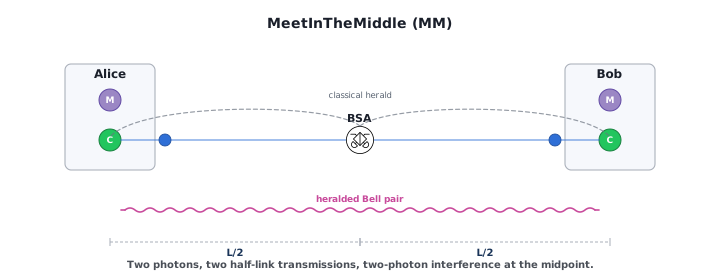
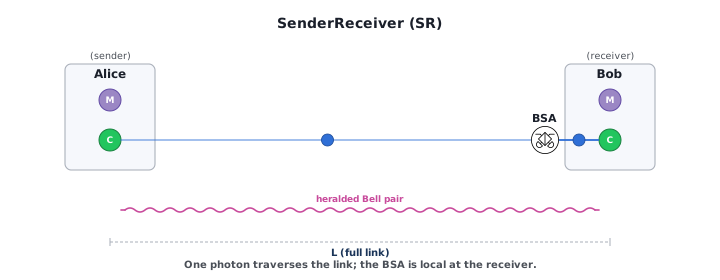
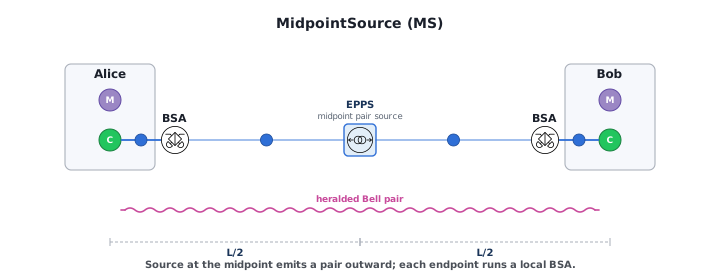
The three architectures, after Jones et al. New J. Phys. 18 083015 (2016) Jones et al. 2016 . Each card pairs the description on the left with a schematic on the right, using a shared visual key — green C comm qubits, purple M memories, blue photons, light-blue QFC / EPPS blocks, dashed BSM glyph, magenta entanglement wavy line.
MeetInTheMiddle (MM)
Each of the two repeater nodes generates a matter-photon entangled pair locally and sends its photon toward the link midpoint. The two photons interfere on a beam splitter at a midpoint Bell-state analyser; a successful coincidence detection erases which-node-emitted-which information and heralds a Bell pair between the two matter qubits. The arrangement behind most current solid-state and ion-trap remote-entanglement experiments Pompili et al. 2021 . Heralding requires two-photon interference; rate scales with full-link transmission.
SenderReceiver (SR)
The sender (Alice) generates a matter-photon pair and sends its photon all the way to the receiver (Bob), who interferes it with a photon entangled with his own memory and runs the Bell-state analyser at his end. Memory qubits are needed only at the receiver; the sender re-tries if a photon is lost. Simpler hardware than MM, but more sensitive to round-trip loss because the photon traverses the full link rather than half Jones et al. 2016 .
MidpointSource (MS)
An entangled-pair source sits at the midpoint and emits one photon outward toward each of the two endpoints, where each is captured by a memory. Heralding here is on the source-side detection of the partner photon, which is more robust to photon loss than two-photon interference at distance — MS achieves higher rates than MM or SR when loss is high. SPDC is the natural device choice for the midpoint source Jones et al. 2016 .
Rate-vs-loss trade-off
The three architectures put their photons through different amounts of fibre, and they condition success on different events. That fixes the loss scaling. Per attempted heralding event, the success probability scales roughly as
- MM — both photons must survive a half-link and interfere, so the rate scales with the square of the half-link transmission, i.e. with full-link transmission.
- SR — the sender's photon must survive the full link; single-photon transmission, but the photon travels the entire distance.
- MS — heralding fires when the source-side partner photon is detected locally, so the heralding rate is independent of the link loss on the photon that actually reaches the memory. Loss still kills the useful rate (the photon has to arrive at the memory to be captured), but the architecture sidesteps the two-photon-interference requirement.
At low loss MM and SR are competitive and MM's symmetry tends to win on fidelity; at high loss MS dominates because heralding doesn't require two-photon interference at distance. Jones et al. work the simulations out in detail and identify the regime crossovers as a function of fibre length, memory coherence, and source-clock rate Jones et al. 2016 .
Heralding and timing
Heralding — a classical signal back to each memory-holding node announcing "your photon was successfully detected at the analyser" — is what turns a probabilistic distribution attempt into a deterministic resource. Two timing constraints apply.
- Coherence budget. The heralding signal must travel back to the memory-holding node before the memory's coherence runs out. For MM and MS this round-trip is one full link time — the memory must hold its qubit through generation, photon emission, propagation to the midpoint, detection, and the classical herald back. For SR the BSA sits at the receiver, so the receiver's memory only needs to span its local generation-plus-detection; the sender does not need a memory at all and simply re-tries. This is what makes SR attractive when memory coherence is the binding constraint.
- Source-clock rate. The source has to fire fast enough that within one coherence time the link gets enough heralding attempts for at least one to succeed. For MM and MS this sets a clock-rate target as a function of loss; for MS specifically, fast SPDC clocks plus single-photon detection give the architecture its high-loss advantage.
Multiplexing
All three architectures are independently composable with multiplexing — running multiple heralding attempts in parallel along axes the link can separate. Three modalities are standard:
- Time-bin multiplexing. The source fires in many distinguishable time slots within one coherence window; the BSA sees them as independent attempts.
- Frequency-bin multiplexing. The source emits across several separable frequency channels, each running an independent heralding pipeline, often via WDM components borrowed from classical optics.
- Memory-qubit multiplexing. Each node holds an array of memory qubits; multiple distribution attempts are kept in flight in parallel, and whichever one succeeds first is promoted to the active pair.
Multiplexing is the lever that makes long-link distribution tractable. The single-attempt success probability shrinks with loss; multiplexing recovers rate by running many attempts per coherence window. The architectural axis (MM / SR / MS) and the multiplexing axis (time / frequency / memory) are orthogonal — a real link picks one of each Kumar et al. 2025 .
Network role
Distribution is the operation that makes the link-layer service contract true RFC 9340 : given a request for a Bell pair between two adjacent nodes, the link runs whatever architecture it is built around (MM, SR, or MS) and delivers a heralded pair at the contracted fidelity and rate. Distribution is the implementation that satisfies the contract on a single link.
Three follow-on subjects build on distribution:
- Repeaters integrate distribution and swapping into the 1G / 2G / 3G architectural families and analyse end-to-end rate-vs-loss scaling. Covered in the repeaters subject.
- Links looks at the physical-layer side: fibre, hollow-core fibre, free-space, and satellite media, and what each costs in attenuation and latency. Covered in the links subject.
- Metrics defines loss, decoherence, and fidelity quantitatively — the inputs the rate-vs-loss curves on this page consume. Covered in the metrics subject.