Entanglement and Bell pairs
A qubit by itself is a richer object than a classical bit, but it is still a local thing. Entanglement is the multi-qubit phenomenon that makes quantum networking a separate discipline — not "wider-bandwidth classical networking" but a different category of service.
The shared resource a quantum network delivers is the Bell pair — also called an EPR pair, after the 1935 Einstein-Podolsky-Rosen paper that first discussed states of this form. A Bell pair is two qubits in a specific maximally entangled state, with one qubit at each of two endpoints. Once a Bell pair is delivered between two distant nodes, users can teleport arbitrary qubits through it, extract a cryptographic key, or run a distributed protocol. The whole of quantum networking reduces to one goal: deliver Bell pairs at adequate rate, fidelity, and reach Kumar et al. 2025 .
What entanglement is
A single qubit's state is with , and measurement in the computational basis collapses it to or with probabilities and . Entanglement is what happens when two of these are composed into a single joint state Kumar et al. 2025 .
For two qubits and , the joint state lives in a four-dimensional space with basis vectors , , , . The notation is just a stacked pair: means qubit A is in and qubit B is in ; means A in , B in ; and so on. A general two-qubit state is a complex superposition over all four of these joint outcomes, with amplitudes whose squared magnitudes sum to 1.
A separable state is one that can be written as a tensor product of two independent single-qubit states, — each qubit has its own state, and the joint state is just A's state and B's state side by side
. An entangled state is one that cannot be written that way: the two qubits do not have individual states of their own, only a single shared state. The canonical example is the Bell state
The pair is in an equal superposition of both qubits are 0
and both qubits are 1
. The in front is the normalising amplitude — Born's rule turns each amplitude into a probability by squaring its magnitude, so each outcome has probability . When Alice and Bob measure their qubits in the computational basis (the standard / basis — H or V for photon polarisation), two things happen at once:
- Each individual outcome is random. Alice sees 0 half the time and 1 half the time; same for Bob. Looked at on its own, either side is a fair coin.
- The outcomes always agree. The joint result is either 00 or 11, each with probability ½. The cross-terms 01 and 10 have amplitude zero — they never happen. Alice and Bob's coins are perfectly correlated, even though either coin in isolation looks random.
Each qubit is locally indeterminate, yet the pair is deterministically correlated. The state has no factorisation into A and B parts, and the correlation persists regardless of how far apart the two qubits are. Bell's theorem proved that this correlation cannot be reproduced by any local classical pre-arrangement: no shared random seed agreed on in advance recovers the same statistics across all measurement bases Bell 1964 .
- Source. The entangled-photon source (EPS) at the centre emits two photons in the joint state , sending one to Alice and one to Bob. Most commonly a non-linear crystal pumped by a laser, in which one pump photon spontaneously down-converts into a pair of lower-energy photons correlated by the conservation laws of the conversion process.
- Polarisation is one encoding among many. A photon can carry a qubit in polarisation, time-bin, phase, frequency-bin, or dual-rail form — the qubits subject covers the menu. The entanglement physics is the same in any encoding; polarisation is the most familiar and the easiest to picture.
- Apparatus. Each station is a polarising beam splitter (PBS, the square with a diagonal interface) followed by two single-photon detectors. The outer-up detector D₀ clicks on the H component, the outer-down D₁ on V — so a single measurement always yields one click, and the slot that lit up identifies the outcome.
- Both stations measure in the same basis. The PBSes here are both oriented H/V. The correlation holds only when Alice and Bob's measurement axes match — both could have chosen diagonal or any other axis and still seen perfect agreement, but a mismatch makes the outcomes follow Malus's law, , instead of locking step. The choice of basis matters; the choice of which basis (so long as both pick the same one) doesn't.
- Inward leg, then split. On the inward leg each photon is a fuzzy cloud with no axis — the polarisation is undefined, in the superposition . When the photon reaches the PBS it continues onto one of the two output beams as a sharp H or V bar, and the eye sees which way it went.
- Time of measurement does not matter. Each cycle randomly picks which side measures first; you'll see one detector's border pulse, then the other's. The second outcome always matches the first — the running history under each detector is identical, and the running string is genuinely random (no
0,1,0,1
pattern; each cycle is an independent fair coin).
The four Bell pairs
There are exactly four maximally entangled two-qubit states — the Bell states. They form an orthonormal basis for the two-qubit Hilbert space and are the resource on which every quantum-network protocol is built.
|Φ⁺⟩
Even parity, symmetric phase. The reference Bell state in most protocols.
|Φ⁻⟩
Even parity, opposite phase. Reached from by applying to either qubit.
|Ψ⁺⟩
Odd parity, symmetric phase. From by applying to either qubit.
|Ψ⁻⟩
The singlet — antisymmetric, the unique rotationally invariant Bell state. From by applying to either qubit.
Why deliver Bell pairs
A network could in principle ferry an arbitrary unknown qubit from sender to receiver — the quantum analogue of a classical packet. The universally adopted approach is the other one: deliver a fixed, known state — a Bell pair — and let the application extract whatever it wants at the endpoints. Two properties make Bell pairs the right resource Kumar et al. 2025 :
- Maximally entangled. No two-qubit state has stronger entanglement than a Bell pair. An application running an entanglement-based protocol cannot do better than the resource it consumes, and Bell pairs are the strongest resource available.
- Convertible to any state by local operations. Once Alice and Bob share a Bell pair, any desired two-qubit state can be produced from it by single-qubit gates applied locally at each end, plus two classical bits exchanged between them. Distributing Bell pairs is therefore enough to support every entanglement-based application at the endpoints.
The alternative — encoding an unknown qubit into a quantum-error-correcting code and sending the encoded block directly through the lossy channel — is the third-generation quantum repeater approach. It eliminates the round-trip latency that gen 1 and 2 repeaters incur, but at QEC overheads well above what current hardware delivers. Until that matures, Bell-pair distribution plus teleportation is what works in practice, and what every fielded entanglement-distribution experiment to date uses. The repeaters subject later in the series goes into the gen 1 / 2 / 3 trade-offs in detail Kumar et al. 2025 Muralidharan et al. 2016 .
How Bell pairs are made
A Bell pair has to exist before anything else in this series matters. This section covers how a pair is generated — what physical device produces the entangled state in the first place. How a generated pair is then distributed (one half placed at each of two distant nodes) is a separate engineering subject covered later in the series Kumar et al. 2025 .
Four families of generation scheme cover the literature, sorted by what the entanglement is between: two photons, photon and ensemble, photon and single matter qubit, or two distant matter qubits. The matter-matter case has a few sub-protocols of its own, listed at the end Forbes et al. 2025 .
1. Two-photon sources (photon-photon entanglement)
Spontaneous parametric down-conversion (SPDC) in a non-linear crystal — PPKTP, BBO, or PPLN — converts a pump photon into a pair of lower-energy photons whose polarisation, time-energy, and momentum are correlated by the conservation laws of the conversion. Pair rates reach the megahertz, bandwidths are broad, and the crystal runs at room temperature, which is why SPDC is the workhorse for BBM92/Ekert91 QKD field deployments and the Micius satellite link Kwiat et al. 1995 Yin et al. 2017 . Both photons are fragile: any loss between source and detector destroys the pair, so the scheme tolerates moderate fibre attenuation but cannot store the entanglement while a classical message catches up. The chip-integrated variant is spontaneous four-wave mixing (SFWM) in silicon-photonic waveguides, which uses the non-linearity to do the same job on a CMOS-compatible platform.
2. Atomic-ensemble emission (DLCZ-style)
The Duan-Lukin-Cirac-Zoller (DLCZ) protocol uses a cold-atom cloud as both source and memory Duan et al. 2001 . A weak write pulse drives a Raman transition that emits a Stokes photon entangled with a delocalised collective spin-wave excitation in the ensemble; the spin wave stays put until a read pulse converts it back into an idler photon entangled with whatever Bell pair the surrounding network has built. The Sangouard 2011 review is the standard reference for the protocol family and its variants Sangouard et al. 2011 . Rare-earth-doped solids — Er³⁺ in silicon photonics, Pr/Eu/Yb in YSO — are the present-day solid-state analogues, packaging the same ensemble physics into a chip-scale memory.
3. Single-emitter matter-photon entanglement
A single quantum emitter — trapped ion, neutral atom, NV or SiV colour centre in diamond, or semiconductor quantum dot — emits one photon entangled with its own electron spin or hyperfine level. The matter qubit then holds the entanglement while the photon flies, which is what every memory-equipped repeater architecture in the series builds on. Demonstrations exist across all four platforms: SiV in nanophotonic cavities over a 35-km Boston-area fibre loop Knaut et al. 2024 , NV centres across three QuTech nodes Pompili et al. 2021 , trapped ions separated by 230 m Krutyanskiy et al. 2023 and across an optical link supporting distributed quantum computation Main et al. 2025 , and neutral-atom nodes 33 km apart Leent et al. 2022 . This is the generation mechanism the workspace's 4-hop topology figure depicts: each SiV repeater node emits a 737-nm photon entangled with the diamond spin, a quantum frequency converter shifts the photon to 1550 nm for fibre transport, and the photon flies to a midpoint Bell-state analyser where it interferes with a partner emitted by the adjacent node.
4. Two-node matter-matter entanglement schemes
The three protocols below all sit on top of single-emitter spin-photon entanglement: they specify how two distant nodes use their emitted photons to produce a matter-matter Bell pair. The literature names and counts them explicitly, so this taxonomy is taken from the source papers rather than synthesised here. The midpoint announcement that completes each scheme — what the swapping page calls heralding — is described in detail there.
- Barrett-Kok (two-photon scheme). Each node emits one photon entangled with its own qubit; the two photons interfere at a midpoint beam-splitter; a coincidence in either output port projects the two distant matter qubits into or Barrett et al. 2005 . Two-photon detection makes the scheme robust to optical-path phase fluctuations, at the cost of a 50% ceiling on success probability set by the linear-optics Bell-state-measurement bound. This is the architecture used by the SiV fibre demonstration Knaut et al. 2024 and corresponds to MeetInTheMiddle on the distribution page.
- Cabrillo (single-photon scheme). Each node has a low excitation probability and emits at most one photon; a single click at a single midpoint detector creates entanglement by erasing which-path information Cabrillo et al. 1999 . At low channel transmission the rate is higher than Barrett-Kok — one photon loss is tolerated instead of two — but the success amplitude depends on the relative optical phase between the two arms, so the interferometer needs sub-wavelength stability over the full link.
- Duan-Kimble (cavity-mediated scheme). A single photon reflects off a cavity-coupled emitter; the photon polarisation acquires a phase shift conditional on the qubit state, entangling photon and qubit deterministically Duan et al. 2003 . The route is less common in field deployments because it requires extreme cavity-emitter cooperativity, but it is the canonical reference for cavity-mediated QND readout and for the deterministic gates that Generation-2 and Generation-3 repeaters assume.
What a Bell pair lets you do
A single qubit's state cannot be copied. The no-cloning theorem says there is no unitary for which for an arbitrary unknown ; copying would violate the linearity of quantum mechanics Wootters et al. 1982 . A signal photon cannot be passed through an amplifier and faithfully reproduced either — any phase-insensitive amplifier must add at least one quantum of noise per mode, which destroys the qubit's state. The consequence is that quantum networks cannot reuse the engineering that makes long-distance classical optical fibre work; the three primitives below replace it.
Each consumes the shared Bell pair (one-shot resource) and uses a classical side-channel for the corrections that complete the protocol. The first two — teleportation and entanglement swapping — invoke a Bell-state measurement; the next section unpacks what that measurement is and how it is built.
Teleportation
Alice has an unknown qubit she wants to transmit to Bob. She performs a Bell-state measurement on together with her half of the shared Bell pair, then sends the 2-bit outcome to Bob over a classical channel. Bob applies the corresponding Pauli correction to his half — which is now in state . The original at Alice is destroyed in the measurement, consistent with no-cloning. Proposed in 1993 Bennett et al. 1993 .
Swapping
A Bell-state analyser (BSA) between Alice and Bob holds one half of each of two short Bell pairs; a Bell-state measurement at the BSA extends the entanglement to the two distant endpoints. See the swapping subject for the full protocol. Proposed in 1993 Żukowski et al. 1993 ; the primitive every memory-based quantum repeater is built on.
Purification
Bell pairs delivered through a noisy channel are mixed states with reduced fidelity. Purification protocols consume two (or more) low-fidelity pairs and produce one higher-fidelity pair, trading throughput for quality. Together with swapping, purification makes long-distance entanglement distribution feasible without per-photon error correction Bennett et al. 1996 .
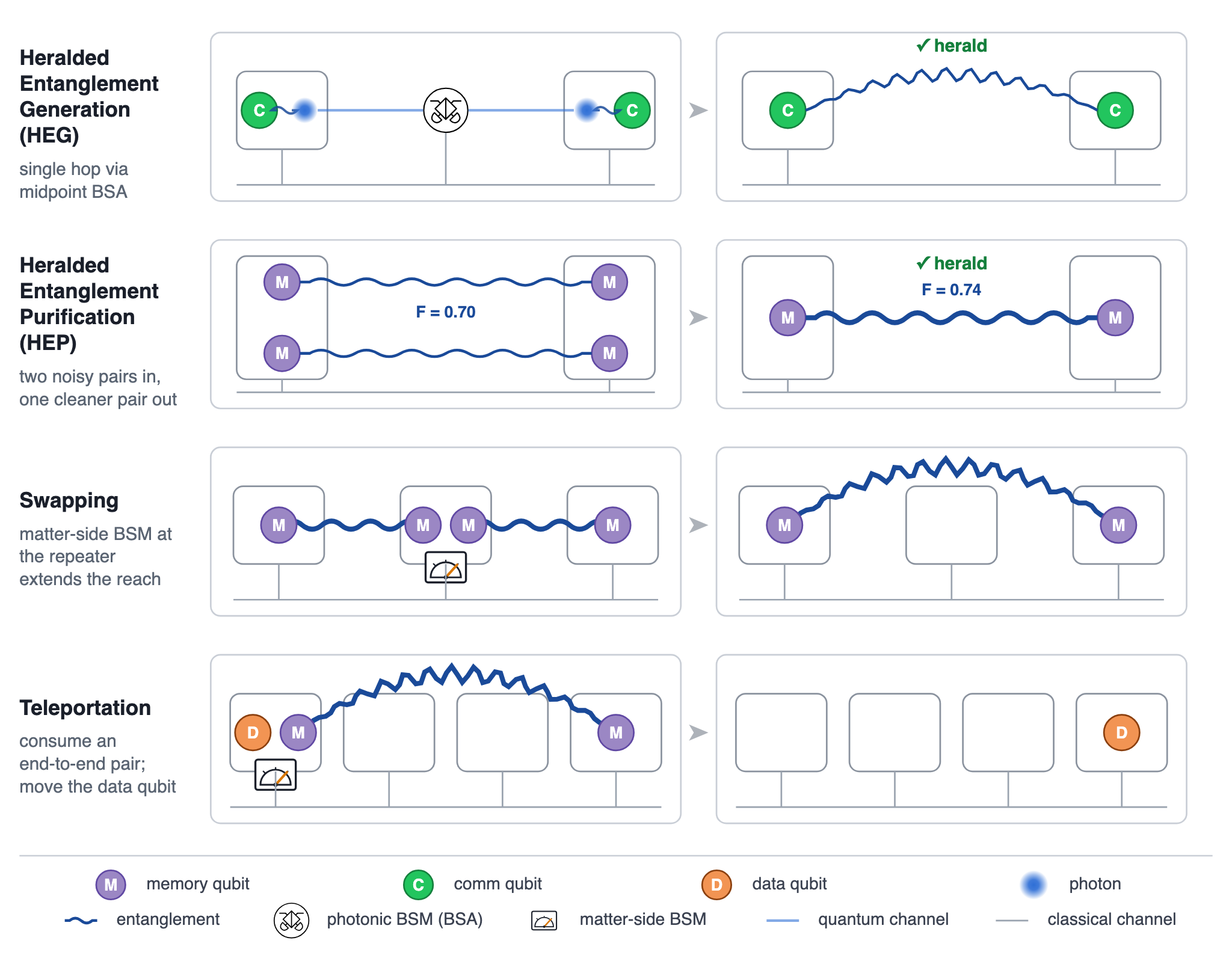
Inspired by Aliro, The Evolution of Quantum Repeaters
Bell-state measurement
A Bell-state measurement (BSM) is a joint measurement on two qubits in the Bell basis. The outcome is one of four labels — , , , — and the two qubits are left in that Bell state. The label is two classical bits; the receiver uses those bits to choose which Pauli correction to apply (, , , or ) and recover the intended state.
BSM is the operational primitive behind both teleportation (Alice does a BSM on her unknown qubit and her half of the shared Bell pair; the 2-bit outcome tells Bob which Pauli to apply) and entanglement swapping (a BSA does a BSM on one half of pair AB and one half of pair BC; the end qubits A and C are left entangled, even though they never interacted).
How a photonic BSM is built
The canonical linear-optics implementation: the two qubits enter a 50:50 beam splitter, the two output ports each go through a polarising beam splitter, and four single-photon detectors sit at the four PBS outputs. Two-photon interference at the central beam splitter routes the photons in a way that depends on the Bell state at the input. The four-detector click pattern is the readout.
The four outcomes. A full BSM resolves all four Bell-basis projections — one 2-bit code per Bell state, mapping directly to the Pauli correction Bob applies on his half of the shared pair Nielsen et al. 2010 :
| BS | PBS | click pattern | Bell state | bits | Bob's correction |
|---|---|---|---|---|---|
| bunched | same detector, same pol | 2× at 1H or 2H | |Φ⁺⟩ | 00 | I |
| bunched | same detector, same pol | 2× at 1V or 2V | |Φ⁻⟩ | 01 | Z |
| bunched | same port, opposite pol | 1H+1V or 2H+2V | |Ψ⁺⟩ | 10 | X |
| antibunched | different ports, opposite pol | 1H+2V or 1V+2H | |Ψ⁻⟩ | 11 | XZ |
Why only half the time, on photonsbelow unpacks. In the history pane, Φ rows are shown muted to flag the post-selection.
Note on inputs. The BSM is fed two photons that are not a Bell state — in teleportation, one is the unknown state |ψ⟩ and the other is Alice's half of a Bell pair shared with Bob (which has no well-defined polarisation state on its own). The two photons must be indistinguishable in wavelength, arrival time, and spatial mode, and they must share the same H/V polarisation basis. HOM interference at the BS sorts the four Bell-basis components by exchange symmetry. The animation samples the projection outcome directly each cycle and replays the click pattern that fires for it.
Why only half the time, on photons
An ideal Bell-state measurement projects onto all four Bell states with equal fidelity. Linear-optics hardware doesn't realise the ideal: it can only distinguish the two Ψ outcomes from each other. The two Φ outcomes (|Φ⁺⟩ and |Φ⁻⟩) bunch at the same single detector with the same polarisation, producing an identical click pattern, so the observer cannot tell which Φ has fired and neither bit code is deliverable. Real linear-optics teleportation post-selects on the Ψ clicks and discards the Φ-pattern shots — 2 of 4 distinguishable outcomes, hence the 50 % ceiling.
The ceiling is fundamental to linear-optics BSM, not a hardware limitation: no arrangement of beam splitters, phase shifters, and detectors that uses only the two input photons can do better. Calsamiglia and Lütkenhaus proved this as an upper bound for dual-rail / polarisation encodings without ancillas Calsamiglia et al. 2001 ; Azuma's review re-derives it next to the click-pattern table for the same apparatus this animation uses Azuma et al. 2023 . Lifting the bound requires either ancilla photons in the apparatus or genuine non-linearity (cross-Kerr media, Rydberg interactions, atom–photon gates). A demonstration exceeding 50 % with squeezed-light ancillas exists Bayerbach et al. 2023 , but at a hardware cost that has not yet entered fielded systems.
How a matter-side BSM is built
A matter-side BSM projects onto the Bell basis using local gates plus measurement, with no photon interference involved. It is performed on two stationary qubits sitting in the same node — two trapped-ion register slots, two NV-centre spins, two superconducting qubits on the same chip, two neutral atoms in the same array — and is deterministic in principle: all four Bell outcomes are distinguishable, no post-selection, no 50 % ceiling.
The standard circuit is CNOT on the pair, then Hadamard on the control qubit, then a single-qubit computational-basis readout of each qubit. The two classical readout bits label the four Bell states one-to-one Nielsen et al. 2010 :
Success probability reduces to the fidelity of the underlying CNOT and readout — today routinely 99 %+ on trapped-ion, neutral-atom, and superconducting hardware — so "close to 100 %" is shorthand for "as good as the gate stack on that platform". The trade is in time: two-qubit gate and readout times are platform-specific (≈10–100 μs gates and ≈100 μs–1 ms readout on trapped ions, ≈1 μs gates on NV, ≈50–300 ns gates on superconducting circuits) Meddeb 2025 , so a matter-side BSM is several orders of magnitude slower than a photonic linear-optics BSM (nanoseconds — set by optical path length plus detector response).
Where each kind is used


The BSM between two distant nodes — for entanglement swapping at a repeater, or for the central node in MDI-QKD Lo et al. 2012 — is performed on photons at a midpoint Bell-state-analyser station, with the photonic 50 % retry overhead baked into the architecture. The matter-side BSM is used inside a single node — to teleport a qubit between two memory slots in the same register, to fuse two adjacent end-to-end pairs at a memory-equipped repeater (matter-side swapping), or to consume an end-to-end pair and a data qubit at Alice's lab (teleportation). Memory-based 1G/2G repeater architectures combine both: a photonic BSA at the midpoint to mint each hop's Bell pair, then a matter-side BSM at the relay to swap two adjacent hops together.
What it takes to deliver Bell pairs
The link-layer service of a quantum network is deliver Bell pair (A, B)
on demand RFC 9340 . Once delivered, the application layer can teleport, purify, swap, or measure as it likes. The network does not transport classical messages or copy arbitrary qubits — it distributes entanglement between named endpoints, and everything else is built on top.
Providing that service end-to-end requires every piece below working at adequate rate, fidelity, and reach. Each is a separate engineering challenge, covered in a dedicated subject later in the series.
- Sources — generate the Bell pairs in the first place (SPDC, atomic-ensemble, single-emitter). Covered above.
- Distribution — place one half of a generated pair at each of two distant nodes across a single link, via one of the MM / SR / MS architectures. Covered in the distribution subject.
- Memory — hold a qubit while its partner photon is in flight, with coherence longer than the link's classical round-trip. Covered in the memories subject.
- Reach extension — chain Bell-state measurements across multiple hops so entanglement spans further than a single link can reach. Covered in the swapping and repeaters subjects.
- Fidelity extension — purification trades two noisy pairs for one cleaner pair, so the delivered fidelity is high enough for downstream use. Covered in the purification subject.
- Physical channel — fibre, hollow-core fibre, free-space, or satellite. Loss bounds reach; the channel choice sets the loss budget. Covered in the links and metrics subjects.
- Protocol stack — link-layer scheduling, routing, addressing, and the classical side-channel needed by every protocol on this page. Covered in the stacks subject.