Spectrum — quantum platforms across the EM range
Eleven platforms span more than five orders of magnitude in transition frequency — from gigahertz superconducting qubits to ultraviolet trapped-ion lines. Wiring them together is the core engineering problem of the quantum internet.
Spectrum chart
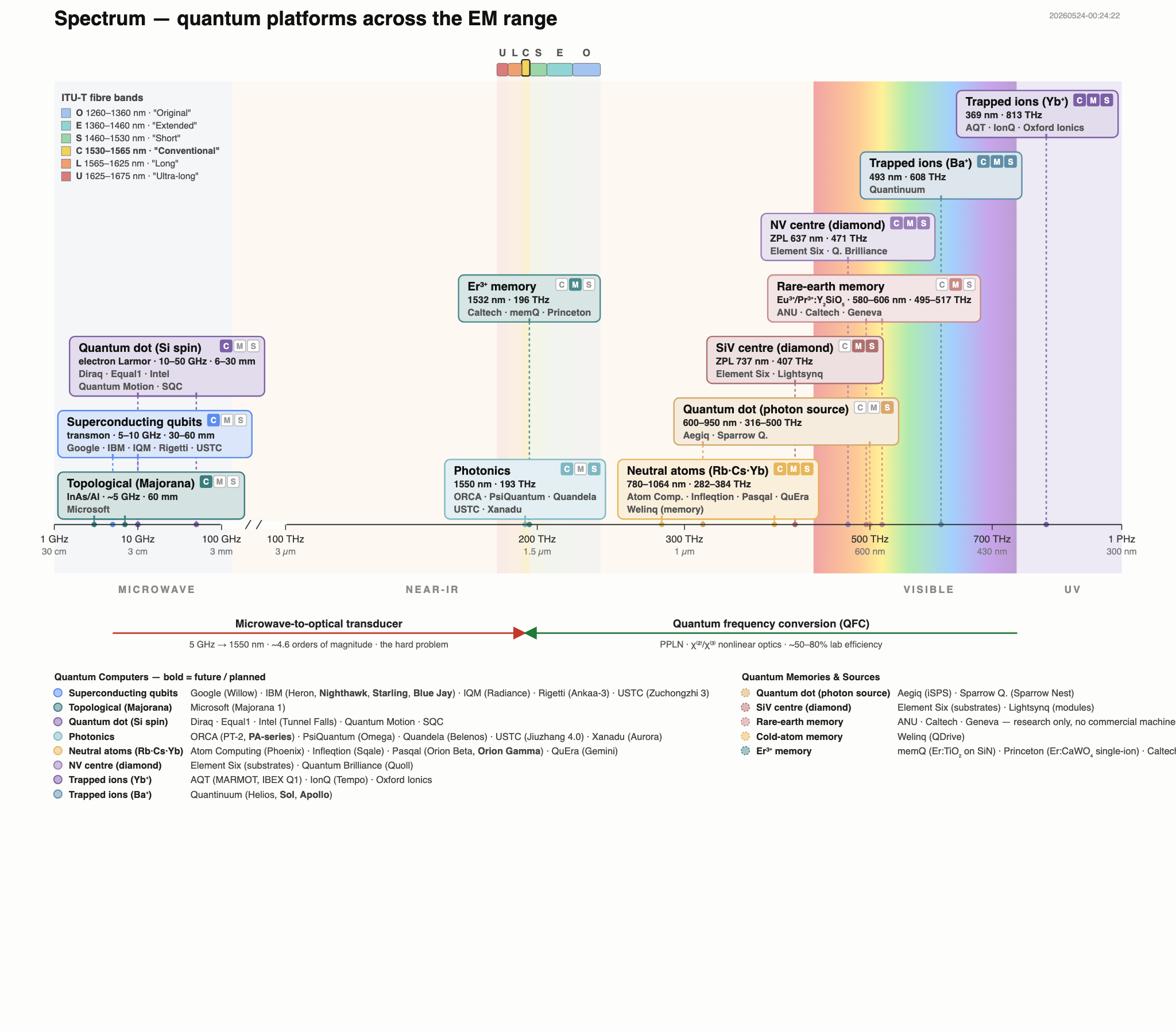
One problem, two regimes
A quantum network has to move a qubit from wherever a platform happens to produce it to the wavelength deployed fibre carries — the telecom C-band around 1550 nm. That is one problem family: shifting a photon's frequency without breaking its quantum state. The two arrows on the chart show it at very different difficulty levels Ezratty 2025 .
The right-hand arrow — quantum frequency conversion (QFC) — converts visible or near-IR photons to telecom using the same χ²/χ³ nonlinear-optics toolkit (PPLN crystals, four-wave mixing) that classical telecom uses for wavelength conversion, operated at single-photon level. Lab efficiencies of 50–80% with low added noise are now routine; this is mostly an engineering problem.
The left-hand arrow — the microwave-to-optical transducer — is the open one. Spanning ~4.6 orders of magnitude forces hybrid physics: optomechanical, electro-optic, magnonic, or atomic-ensemble bridges between superconducting microwave qubits and an optical mode. Coherent, quantum-noise-limited efficiencies are still well under 1%. Until that number climbs, every microwave quantum computer effectively cannot leave its cryostat.
The computers
A gate-model quantum computer runs algorithms by applying one- and two-qubit gates to an array of qubits — the architecture Shor's factoring, quantum chemistry, and most near-term applications target. Each platform below is a different physical recipe for making a qubit, and each operates its qubit at a transition frequency set by the underlying physics: Josephson-junction energy for superconducting qubits, an electron spin precession for silicon, an atomic hyperfine split for trapped ions Ezratty 2025 .
When scanning the cards, the questions worth asking are: how many qubits has the vendor demonstrated, how mature is the fidelity, and is there a credible roadmap beyond the current flagship? Vendors with multiple named generations on a public schedule (IBM's Heron → Nighthawk → Starling → Blue Jay; Pasqal's Orion line) are the strongest signal that a platform will keep scaling.
Superconducting qubits
Computertransmon · 5–10 GHz · 30–60 mm
Flagship machines Google (Willow) · IBM (Heron, Nighthawk, Starling, Blue Jay) · IQM (Radiance) · Rigetti (Ankaa-3) · USTC (Zuchongzhi 3)
Topological (Majorana)
ComputerInAs/Al · ~5 GHz · 60 mm
Flagship machines Microsoft (Majorana 1)
Quantum dot (Si spin)
Computerelectron Larmor · 10–50 GHz · 6–30 mm
Flagship machines Diraq · Equal1 · Intel (Tunnel Falls) · Quantum Motion · SQC
Photonics
Computer1550 nm · 193 THz
Flagship machines ORCA (PT-2, PA-series) · PsiQuantum (Omega) · Quandela (Belenos) · USTC (Jiuzhang 4.0) · Xanadu (Aurora)
Neutral atoms (Rb·Cs·Yb)
Computer780–1064 nm · 282–384 THz
Flagship machines Atom Computing (Phoenix) · Infleqtion (Sqale) · Pasqal (Orion Beta, Orion Gamma) · QuEra (Gemini)
NV centre (diamond)
ComputerZPL 637 nm · 471 THz
Flagship machines Element Six (substrates) · Quantum Brilliance (Quoll)
Trapped ions (Yb⁺)
Computer369 nm · 813 THz
Flagship machines AQT (MARMOT, IBEX Q1) · IonQ (Tempo) · Oxford Ionics
Trapped ions (Ba⁺)
Computer493 nm · 608 THz
Flagship machines Quantinuum (Helios, Sol, Apollo)
The memories and sources
Quantum memories store an arriving photon's qubit state long enough — milliseconds to seconds — to wait for a partner photon from another node, so two distant computers can share entanglement and execute distributed protocols. Photon sources emit single photons or entangled photon pairs on demand. Without these components, qubits never leave the chip they were created on; with them, the quantum internet is buildable Meddeb 2025 .
Three details worth noticing as you scan the cards:
- Every memory and source emits at a different wavelength — and only Er³⁺ (1532 nm) sits naturally in the telecom C-band. Everything else needs frequency conversion before it can travel deployed fibre, which is the second of the two arrows on the chart above.
- NV centre and SiV centre are siblings, both colour centres in diamond. NV is sold as a small-scale computer (Quantum Brilliance's Quoll) because it works at room temperature; SiV has the cleaner optical interface and is the memory variant (Lightsynq, Lukin/Harvard).
- Welinq's QDrive memory runs on Rb cold atoms — the same physics as the neutral-atom computers from Atom Computing, Pasqal, QuEra — so it appears inside the Neutral atoms box on the chart, not as a standalone memory swatch.
SiV centre (diamond)
MemoryZPL 737 nm · 407 THz
Flagship machines Element Six (substrates) · Lightsynq (modules)
Rare-earth memory
MemoryEu³⁺/Pr³⁺:Y₂SiO₅ · 580–606 nm · 495–517 THz
Flagship machines ANU · Caltech · Geneva — research only, no commercial machines
Er³⁺ memory
Memory1532 nm · 196 THz
Flagship machines memQ (Er:TiO₂ on SiN) · Princeton (Er:CaWO₄ single-ion) · Caltech (Er:Y₂SiO₅)
Quantum dot (photon source)
Source600–950 nm · 316–500 THz
Flagship machines Aegiq (iSPS) · Sparrow Q. (Sparrow Nest)
The fibre window
Telecom fibre carries quantum signals best between 1260 nm (O-band) and 1675 nm (U-band), with the C-band (1530–1565 nm) at the loss minimum ITU-T G.694.2 . Anything not already at telecom — superconducting microwaves, NV-centre red, trapped-ion UV — has to cross to the C-band before it can travel.
| Band | Range | Name |
|---|---|---|
| O | 1260–1360 nm | Original |
| E | 1360–1460 nm | Extended |
| S | 1460–1530 nm | Short |
| C | 1530–1565 nm | Conventional |
| L | 1565–1625 nm | Long |
| U | 1625–1675 nm | Ultra-long |
Reading the chart
A few visual conventions carry most of the meaning:
- Three letter chips at the top-right of each box mark which roles the platform fills:
Ccompute,Mmemory,Ssource. Filled chips are roles the platform supports today; outlined chips are roles it doesn't. Multiple filled chips signal a dual- or triple-use platform — common for trapped ions, neutral atoms, NV centre. - Horizontal position is the platform's signature transition frequency, on a log axis broken between the gigahertz and terahertz regimes (most platforms cluster in the optical band, so the microwave segment is compressed to keep the chart legible).
- Coloured strip across the top shows the ITU-T fibre bands. The highlighted C-band (1530–1565 nm) is where deployed telecom fibre has its loss minimum — every platform that wants to travel between nodes has to reach this wavelength.
- Two arrows converging on the C-band are the chart's main story. They are the same problem — frequency conversion preserving quantum coherence — at very different difficulty levels: the right-hand QFC arrow (visible→telecom) is well-developed nonlinear optics; the left-hand microwave→optical transducer spans ~4.6 orders of magnitude and is still the field's hardest open device.
- Hovering a box highlights it and brings its dotted leader line forward; clicking jumps to the matching detail card.
This page is a companion to the QNTaxo report, chapters 2–3 (foundations and network building blocks) and chapter 7 (vendor landscape) Kumar et al. 2025 .