Quantum Network Infographics
This site documents what I've learnt about quantum networking — long-scrolling pages from what is a qubit through entanglement distribution and protocols to vendors and TRL.
One aim is accurate animations of the concepts that are hard to picture from text alone — entanglement generation, swapping, teleportation, the fibre-photon-pBSM pipeline. Where a still image gets fuzzy, the animation makes the order of operations and the resource flow unambiguous.
A caveat on the data. Much of the data collection, the animations, and the prose drafting is done with AI assistance. Hallucinations are getting rarer but still slip in occasionally. If you spot an error, have more current information, or have an idea for a concept worth animating, the feedback page is the place to say so.
If you take one thing away from this site
Four basic operations on a quantum network
Heralded entanglement generation, heralded entanglement purification, entanglement swapping, and teleportation — composed in roughly that order to deliver an end-to-end Bell pair and then consume it. The rest of this site unpacks each in detail; this one figure is the through-line.
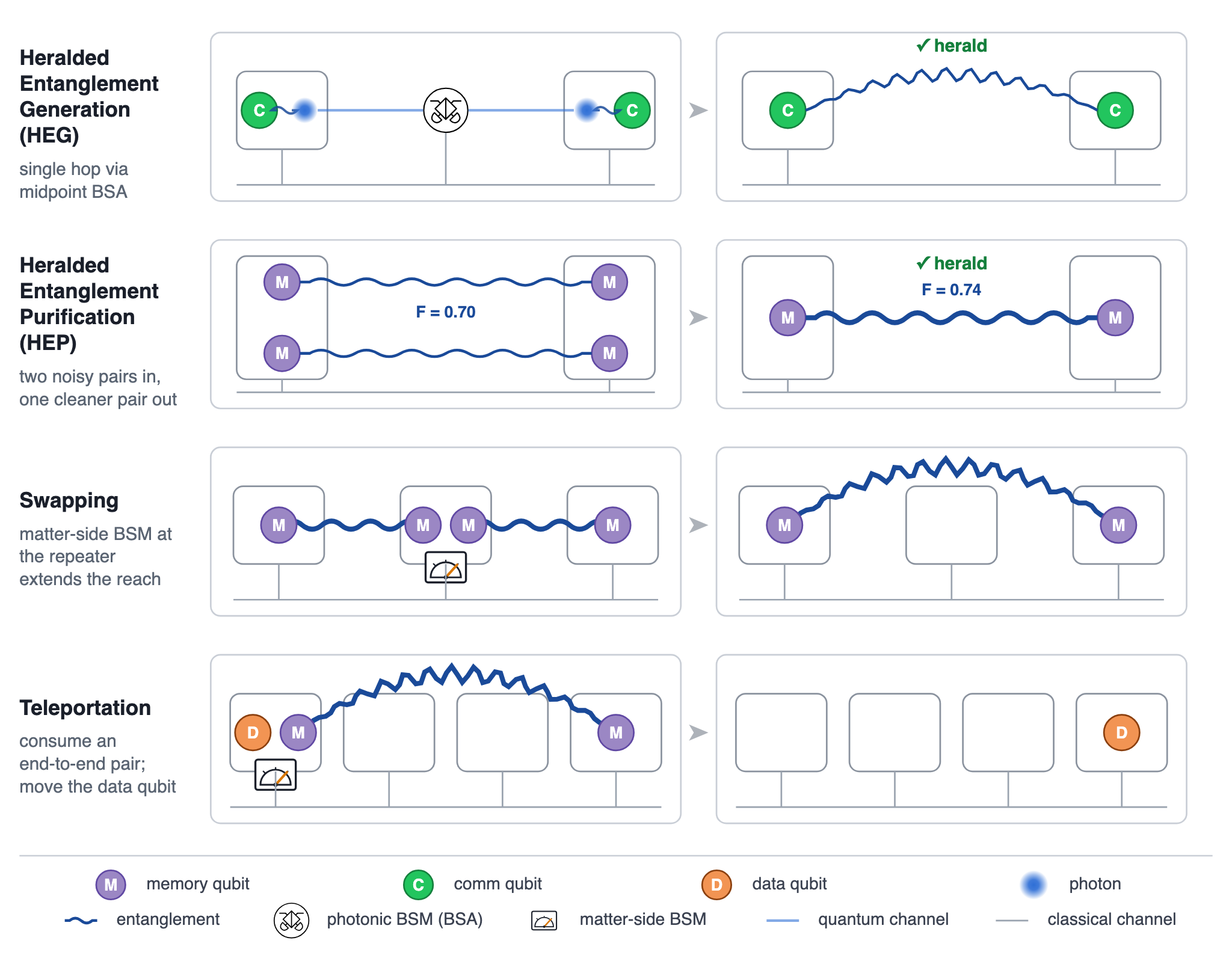
Inspired by Aliro, The Evolution of Quantum Repeaters
Available now
Foundations
Qubits
Modalities, encodings, what 0 and 1 actually mean in each platform — the vocabulary every other subject builds on.
Open →Foundations
Entanglement
What makes the network-relevant correlations stronger than classical correlation, and why Bell pairs are the resource quantum networks deliver.
Open →Foundations
Teleportation
How a shared Bell pair plus two classical bits transfers an unknown qubit. The fundamental quantum-internet primitive — the network's replacement for sending a copy.
Open →Foundations
Swapping
Bell-state measurement at a relay station joins two Bell pairs into one across a longer distance, without the endpoints ever interacting. The primitive every memory-based repeater is built on.
Open →Foundations
Purification
Why fidelity matters for distributed protocols, and the BBPSSW pattern of trading two low-fidelity pairs for one higher-fidelity pair. Also called distillation.
Open →Foundations
Loss & Errors
The two impairments a quantum network has to manage — channel loss (which HEG fights) and qubit errors as fidelity + decoherence (which HEP fights). Grounded in fibre 0.20 dB/km, hollow-core 0.091 dB/km, memory T₂, and Bell-pair fidelity thresholds.
Open →Components
Quantum memories
Storage time, fidelity, and TRL across atomic ensembles, trapped ions, solid-state defects, quantum dots, photonic, and superconducting memories.
Open →Components
Transduction
Bridging microwave qubits to telecom and visible-band photons to telecom — the two open problems on the frequency axis.
Open →Components
Spectrum
Eleven qubit, memory, and photon-source platforms placed by transition frequency, with vendor flagship machines and the C-band fibre window.
Open →Network
Entanglement distribution
Multi-hop swap chains, why MidpointSource wins on long links, and the layered service contract of an entanglement-delivery network.
Open →Network
Quantum repeaters
Three architectural families compared side by side, including the 50 % linear-optics BSM ceiling and the boosted-BSM workarounds.
Open →Network
All-photonic repeaters
Tree- and graph-state distribution as an alternative to memory-based repeaters — Azuma 2015 and the architectures it inspired.
Open →Network
Links
Where each link medium wins on loss, latency, and reach. ITU fibre bands, hollow-core attenuation, FSO atmospheric turbulence, and Micius-style satellite links.
Open →Network
Stacks
Wehner / Van Meter / RFC 9340 stacks side by side, the link-layer service primitive, and how naming and addressing are deliberately deferred.
Open →Applications
Applications
Distributed quantum computing, blind quantum computing, position verification, and multiparty consensus — what each needs from the network.
Open →Applications
Secure communication
Why QKD exists: symmetric encryption needs a shared key, and the three ways to distribute it — classical public-key (RSA/ECDH, broken by a CRQC), post-quantum ML-KEM, and QKD — differ in what their security rests on. Plus how QKD is realised on the network (BB84, BBM92, MDI-QKD, TF-QKD, HD-QKD).
Open →Applications
Sensing
Sensing where the network is load-bearing: entangling sensors at separated nodes to beat the standard quantum limit on a global parameter. Networked atomic clocks, quantum-enhanced telescopy, and distributed estimation, with a reviewed reading list to the primary papers.
Open →Applications
Maturity & TRL
Purohit's QTRL framework over Meddeb's per-platform memory-TRL benchmark, with capability-aware ratings rather than one-size-fits-all numbers.
Open →Ecosystem
Companies
A growing per-vendor index with milestone timelines, public roadmaps, and links to canonical announcements. Maintained as the field evolves.
Open →Ecosystem
Academia
Sibling to Companies — university research groups and principal investigators (Pan Jianwei at USTC, Lukin at Harvard, Hanson at Delft, Simmons at UNSW, …) carrying the field's experimental load. Same dossier shape as Companies, scoped to academic teams.
Open →Ecosystem
Case studies
Operational and recently-operating quantum networks profiled with operator, location, technology family, scale, status, and commercial model. Covers commercial QKD trunks, entanglement-based testbeds, and the new commercial QNaaS model.
Open →Reference
Records
Distance and time records for QKD, entanglement distribution, qubit coherence, and memory storage — sortable tables grounded in primary peer-reviewed sources.
Open →Reference
Standards
A live catalogue of quantum-tech standards and standardisation work across ITU-T, ETSI, IETF, IEEE, ISO/IEC, GSMA, and national bodies. Filterable by topic (QKD protocol, QKD network, entanglement-based quantum network, security, sensing, QRNG, crypto, policy) and status.
Open →